
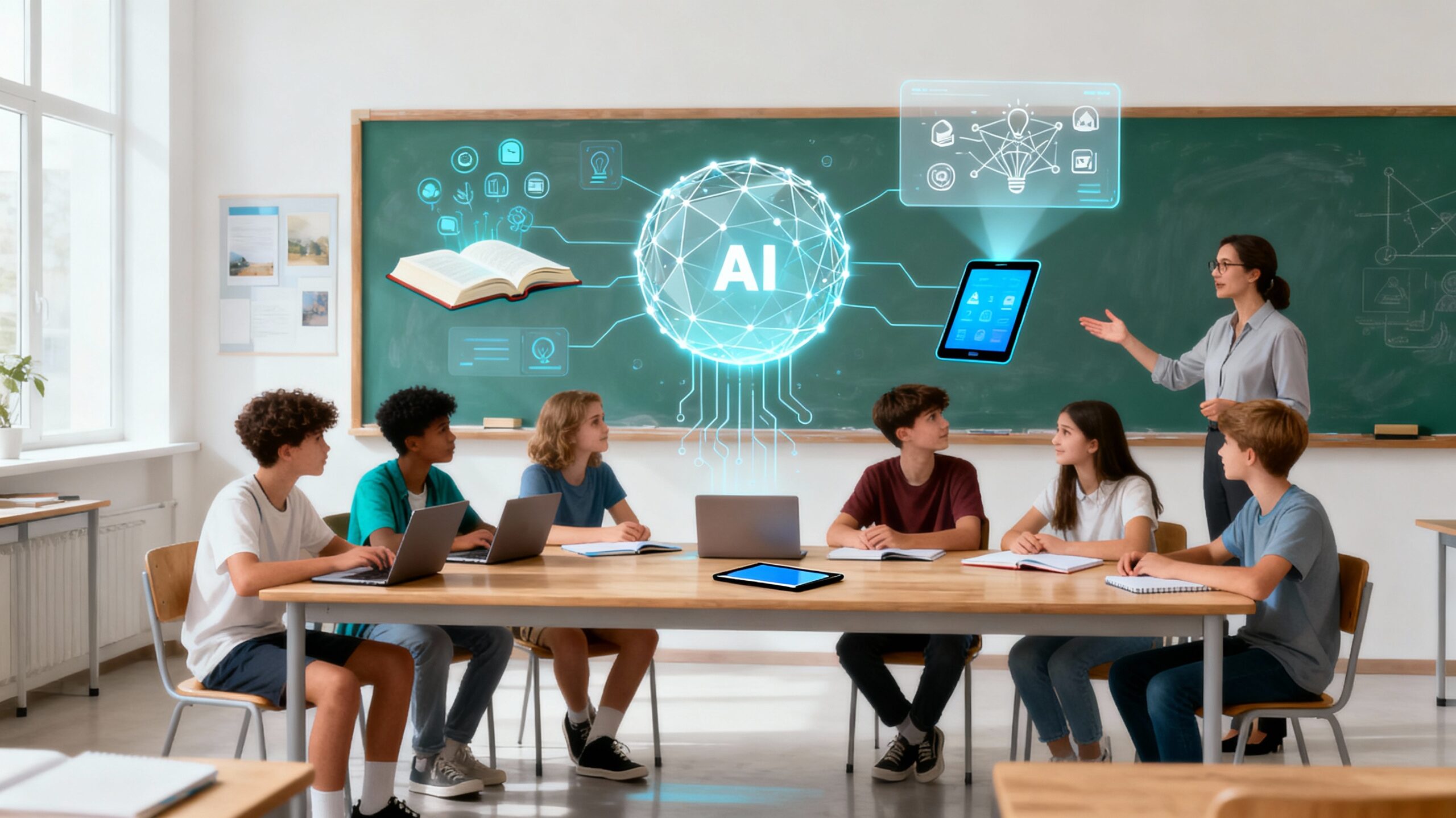
Hi, I’m Heather Sherburn, and if you’re anything like me, the idea of AI in the classroom can feel…a little scary. Maybe a lot scary. We’ve all heard the headlines about AI “replacing teachers,” or about students using AI to shortcut learning, and it’s enough to make anyone pause. I get it. I’ve been there.
But here’s the thing: AI doesn’t have to be something we fear. In fact, if we learn how to use it well, it can become one of our most powerful allies in teaching.
The Urgency Is Real
AI isn’t coming next year—it’s here now. Tools like ChatGPT and other generative AI platforms are already changing how students learn and how teachers plan lessons. The question isn’t if we need to understand AI—it’s how soon we start. If we wait, we risk being left behind while our students are already interacting with these technologies.
That’s why I’m so excited about the Generative AI for Educators Specialization through the SchoolDay Teacher Academy, powered by Coursera. It’s designed to help teachers like us learn how to use AI thoughtfully—without replacing the learning that matters or the critical role teachers play in our students’ lives.
I Get It—AI Can Be Scary
When I first started exploring AI for teaching, I had a lot of doubts. Would my students start relying on it too much? Would it make my teaching feel less personal? Could it really support learning in meaningful ways?
Here’s what I learned: high-quality AI isn’t about taking over our jobs. It’s about helping us do what we already do, but better. Imagine having an assistant who can:
- Help with lesson planning so we spend less time staring at a blank screen
- Generate differentiated learning materials for students with varied needs
- Provide instant feedback on student work, freeing up time for more meaningful interactions
That’s not replacing us—it’s giving us space to focus on what matters most: teaching and connecting with our students.
AI in Action: Some Surprising Examples
To make this real, here are a few ways teachers are already using AI in classrooms—and the results are pretty amazing:
VR + AI: Quiklearn’s Immersive History Adventures
In a 6th-grade classroom in Florida, students aren’t just reading about Cleopatra—they’re chatting with her. Using Quiklearn, a VR-powered AI learning platform, students enter vibrant 3D worlds where historical figures like Cleopatra, Galileo, and Harriet Tubman become interactive tutors. The AI adapts its responses to each student’s questions, guiding them through personalized lessons in history, geography, and science. One student, curious about ancient Egypt’s economy, asks Cleopatra directly—and gets a tailored explanation with visuals and examples. Teachers track progress in real time, seeing which topics students mastered and where they need help. It’s not just VR—it’s living history, powered by AI.
Scribo AI: Writing Feedback That Actually Teaches
At United World College in Singapore, 10th-grade students use Scribo AI to transform their essays into learning moments. When Aisha submits her handwritten draft on climate policy, Scribo instantly analyzes grammar, structure, and clarity, offering real-time feedback aligned with curriculum standards. Instead of vague comments, she gets actionable suggestions—like strengthening her argument with evidence or improving sentence flow. Her teacher sees class-wide analytics showing common struggles, allowing for targeted mini-lessons. Over time, Aisha’s writing improves dramatically, and her confidence soars. Scribo doesn’t just grade—it teaches, tracks progress, and lightens the teacher’s load.
Grokkoli: Math Tutoring That Closes the Gap
In a special education classroom in Missouri, 4th-grader Eli struggles with multiplication and often disengages. His teacher introduces Grokkoli, an AI math tutor designed for differentiated instruction. Eli logs in and the system adapts instantly to his pace, offering scaffolded support and encouragement. When he gets stuck, Grokkoli breaks down the problem visually and verbally, just like a human tutor would. After three sessions a week, Eli begins closing the gap with his peers—progressing at twice the rate of general-ed students in early pilot studies. His teacher notices fewer behavioral issues and more focused engagement. Grokkoli isn’t just a tool—it’s a breakthrough in equity.
MagicSchool AI: The Teacher’s Time-Saving Sidekick
At a busy high school in Chicago, Ms. Ramirez teaches five sections of biology. She uses MagicSchool AI to generate differentiated lesson plans, exit tickets, and even parent emails. When grading short-answer quizzes, the AI flags misconceptions and highlights key concepts, saving her hours. She spends that time mentoring students and refining her instruction. “It’s like having a co-teacher who handles the paperwork,” she says. MagicSchool doesn’t just automate—it empowers.
AI for Neurodiverse Learners: CogniAble’s Executive Function Boost
In a California school for neurodiverse students, 14-year-old Jordan, who has ADHD, uses CogniAble to stay on task. The AI breaks assignments into manageable steps and offers nudges when he gets distracted. It even detects signs of frustration and suggests calming strategies or prompts a teacher check-in. Over time, Jordan builds executive functioning skills and becomes more independent. His parents say he’s more confident and less anxious. For Jordan, AI is scaffolding for success
These are not far-off sci-fi scenarios—they’re happening now. And they show just how much AI can enhance what we already do as educators.
The Exciting Possibilities
Once we embrace AI as a tool rather than a threat, we’ll start seeing its real potential. It can:
- Save us hours on administrative and planning tasks
- Help prevent burnout by streamlining repetitive work
- Support students quickly in ways that are personalized, timely, and responsive to their individual learning need.
In short, it makes us more effective teachers—and helps our students engage more deeply with their learning.
Why You Should Explore AI Now
The truth is, AI in education is here to stay. The earlier we learn how to use it well, the sooner we can harness it to improve our teaching and our students’ learning experiences. The Generative AI for Educators specialization is a practical, hands-on way to do that. It walks you through real strategies you can apply immediately, all in a flexible, self-paced format.
If you’re ready to explore AI in a way that’s practical, meaningful, and actually helpful for your classroom, I encourage you to check out the course here: Generative AI for Educators – SchoolDay Academy.
Let’s not just keep up with AI—let’s use it to teach smarter, not harder, and help our students thrive.